Susan & Mark Feinglos Grief Support Initiative
Advancing Grief-Informed Care Within the Healthcare System

In healthcare, grief is not a single moment. It is ongoing, layered, and shared across patients, families, and providers. Families often feel unprepared for the emotional realities of illness and loss. Providers carry significant, often unacknowledged emotional labor. Grief support is rarely integrated into clinical systems in a sustained way.
This initiative aims to change that.
The Initiative

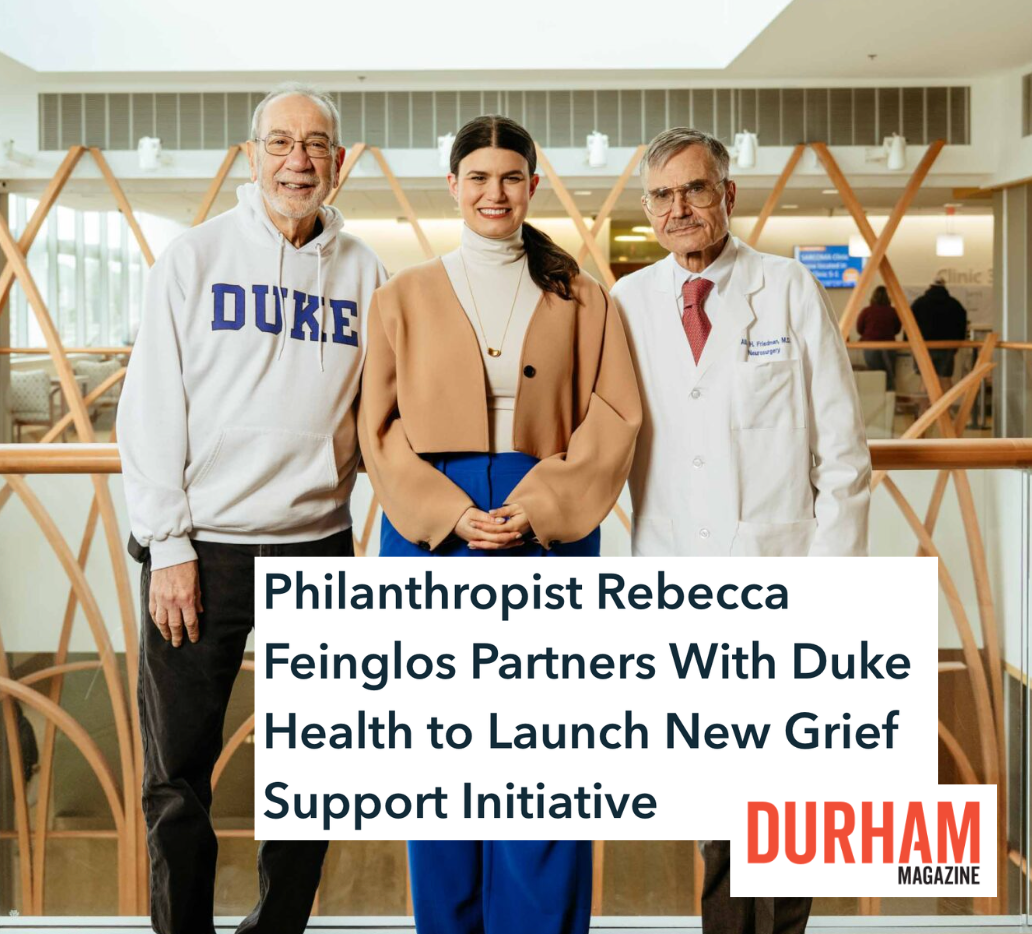
The Susan & Mark Feinglos Grief Initiative is a first-of-its-kind collaboration between the Feinglos Fund, PAUSE, and the Preston Robert Tisch Brain Tumor Center at Duke. It aims to explore what grief-informed care can look like within both a leading healthcare institution and Durham’s unique community.
Rather than focusing solely on bereavement after death, the initiative recognizes that grief is present throughout our journeys through healthcare ~ from diagnosis and treatment to uncertainty, recurrence, survivorship, end-of-life, and beyond. Patients, families, and healthcare providers all experience grief differently, yet their experiences are deeply interconnected. This initiative seeks to better understand those experiences and design practical, sustainable ways to support them together.
The initiative was established through a $250,000 founding gift from Rebecca Feinglos, founder of the North Carolina-based Feinglos Fund and Grieve Leave. Rebecca's vision for this work is rooted in both personal experience and professional expertise. After her mother, Susan Feinglos, was diagnosed with glioblastoma, Rebecca witnessed firsthand the profound emotional impact that serious illness has on patients, families, and the clinicians who care for them. As a certified grief support specialist and a second-generation member of the Duke community, she envisioned a model that would embed grief care within oncology ~ not as an afterthought, but as an essential component of compassionate, whole-person care.
Why PAUSE?
Grief is one of the most universal human experiences ~ and one of the least supported within many of the systems we rely on most. While healthcare systems are designed to diagnose, treat, and cure, they are often not designed to recognize or respond to the emotional realities that accompany serious illness, caregiving, uncertainty, and loss.
PAUSE was founded to help bridge that gap.
Our work sits at the intersection of identity, grief, healthcare, and human-centered design. Rather than delivering one-time programs or creating standalone services, we partner with organizations to better understand how grief is experienced within their unique context and to co-design practical, sustainable solutions alongside the people most impacted.
We believe the people closest to a challenge are also closest to its solutions. That means listening before recommending, understanding before designing, and building with communities rather than for them.
This approach makes PAUSE uniquely positioned to lead the discovery and co-design phase of the Susan & Mark Feinglos Grief Initiative. Throughout this work, our role is not to arrive with predetermined answers, but to create the conditions for patients, families, providers, staff, and community members to collectively shape what grief-informed care can become.
Together, we hope to co-develop not only meaningful improvements for one place, but rather a model that can inform how healthcare organizations across the country recognize, support, and respond to grief.


Project Team

Rebecca Feinglos
Founder, Feinglos Fund
Alica Forneret
Founder & Executive Director, PAUSE
Programs Manager, PAUSEStevie Luna Ibarra

Shante DeLoach
Events and Operations Manager, PAUSE
Jenna Yeam
Research Consultant, PAUSE
Mockingbird Analytics
Evaluation Consultant, MockingbirdOur Approach
Because grief infrastructure is complex, relational, and distributed across multiple systems, the project begins by developing a shared framework for learning before attempting to design solutions. This phase ensures that subsequent data collection is grounded in both evidence and community-informed practice. Developmental evaluation literature suggests that when initiatives are still evolving, evaluators should focus first on building learning systems capable of adapting as new information emerges.
In order to conceptualize this grief infrastructure specific to the place and people of the South, Durham, and the Duke health oncology ecosystem, we anticipate leveraging a mixed-method participatory evaluation. This participatory, trauma-informed, and systems-oriented mixed-methods approach is designed to understand grief not only as an individual experience, but also as a feature of institutional systems, relationships, workflows, culture, and community trust.
Rather than evaluating people, the evaluation seeks to understand how grief is currently held, supported, fragmented, or made invisible across the ecosystem. Because the purpose of Phase 1 is learning, mapping, and design readiness, the evaluation will prioritize sensemaking, relationship-building, systems mapping, and co-interpretation of findings. Advisory councils and stakeholders will serve as partners in shaping questions, interpreting findings, and identifying implications for future pilot design.
This approach draws from participatory developmental evaluation, community-based participatory research (CBPR), developmental evaluation, and trauma-informed evaluation literature, all of which emphasize shared ownership of learning, ongoing reflection, relationship-building, and the use of evaluation as a tool for systems change rather than compliance.
Goals & Objectives
-
PAUSE will identify, document, and synthesize existing grief-related programs, workflows, informal practices, support resources, and institutional gaps across the Duke Health, The Preston Robert Tisch Brain Tumor Center, and Durham’s wider care ecosystem in order to develop a shared understanding of current grief infrastructure and opportunities for coordination.
-
PAUSE will engage patients, families, providers, and Durham community stakeholders in trauma-informed learning processes to identify priorities, barriers, and opportunities for grief-informed support across clinical and community settings.
-
PAUSE will develop a preliminary grief infrastructure framework and pilot readiness strategy that identifies feasible, community-informed, and institutionally sustainable opportunities for future implementation within The Preston Robert Tisch Brain Tumor Center.
-
PAUSE will establish and strengthen collaboration and shared learning among institutional stakeholders, community grief leaders, and advisory groups in order to support long-term, culturally responsive grief infrastructure development.
Evaluation Domains
-
PAUSE will identify, document, and synthesize existing grief-related programs, workflows, informal practices, support resources, and institutional gaps across the Duke Health, The Preston Robert Tisch Brain Tumor Center, and Durham’s wider care ecosystem in order to develop a shared understanding of current grief infrastructure and opportunities for coordination.
-
PAUSE will engage patients, families, providers, and Durham community stakeholders in trauma-informed learning processes to identify priorities, barriers, and opportunities for grief-informed support across clinical and community settings.
-
PAUSE will develop a preliminary grief infrastructure framework and pilot readiness strategy that identifies feasible, community-informed, and institutionally sustainable opportunities for future implementation within The Preston Robert Tisch Brain Tumor Center.
-
PAUSE will establish and strengthen collaboration and shared learning among institutional stakeholders, community grief leaders, and advisory groups in order to support long-term, culturally responsive grief infrastructure development.
The Timeline
-
Purpose: To establish the evaluation infrastructure, learning systems, and shared understanding needed to guide a participatory, trauma-informed exploration of grief within the Duke oncology ecosystem.
-
Purpose: To understand how grief is currently supported, coordinated, and experienced across Duke and Durham while building the relationships necessary for meaningful participation throughout the project.
-
Purpose: To understand how grief, support, communication, trust, and care are experienced by providers, patients, families, caregivers, and community members.
-
Purpose: To bring together findings across all evaluation domains and identify what a more connected grief infrastructure could require.
-
Item descriptionPurpose: To consolidate learning from Phase 1 and establish a clear pathway toward future pilot development and implementation. The goal of evaluation is not simply to produce findings; it is to support action. This final phase focuses on translating insights into practical guidance and learning products to inform future investment, partnership development, and pilot design.
Read About The Initiative
What Happens When We Build Grief Into Infrastructure?; PAUSE Blog 2026

Before We Build Anything; PAUSE Blog 2026
The Problem Isn’t Absence, It’s Fragmentation; PAUSE Blog 2026